Risk in Investment: Understanding the Price of Profit
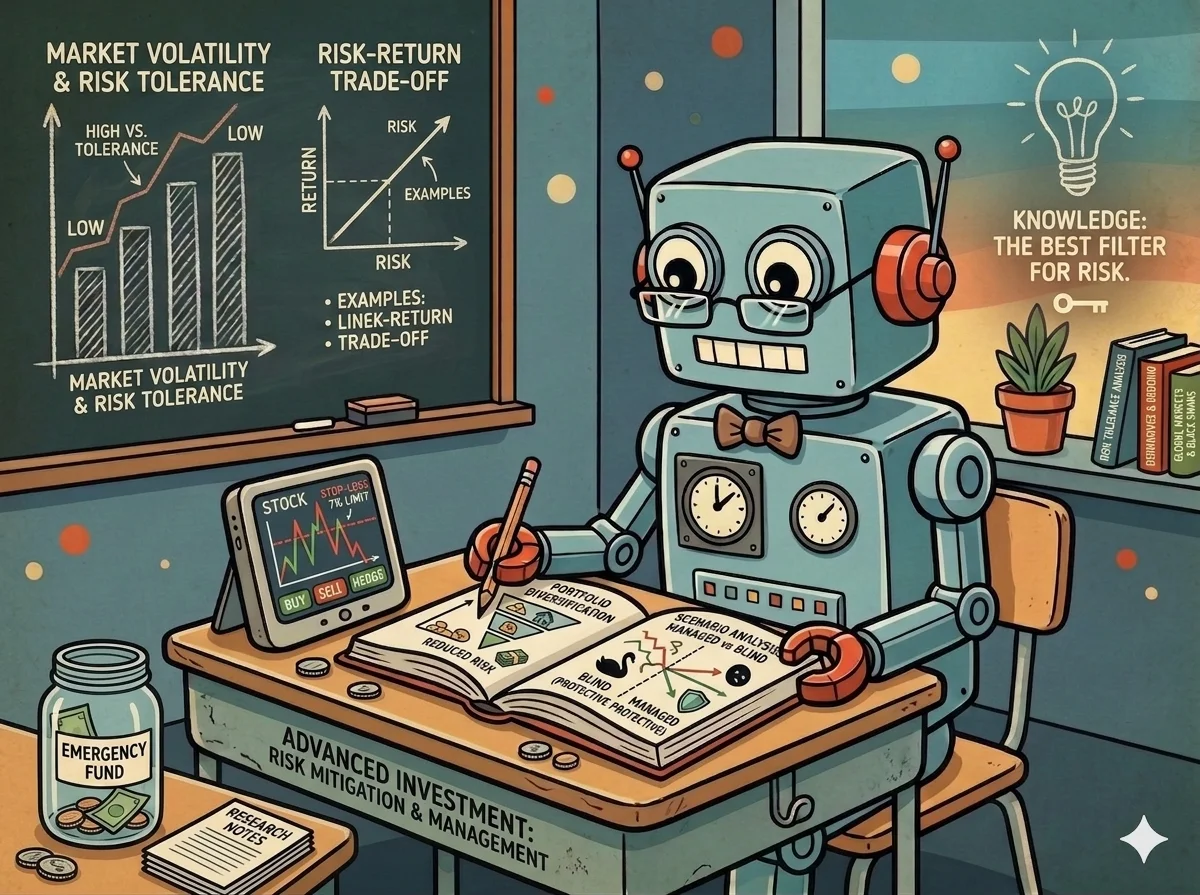
1. What is Risk?
In finance, risk is the volatility or uncertainty regarding future rates of return. Specifically, it is the probability that the actual return will be lower than the expected return, or even lead to a loss of the original principal.
Examples of Risk
- In Daily Life:
- Health Risk: A healthy person suddenly facing a critical illness, resulting in high medical costs and loss of income.
- Weather Risk: You organize an outdoor event, but an unexpected heavy downpour ruins the experience and causes financial loss.
- In Investment:
- Market Risk: You purchase shares of Company A at 50,000 VND/share, expecting the price to rise. However, due to a global economic crisis, the price drops to 30,000 VND.
- Liquidity Risk: You invest in land in a remote area. When you need urgent cash for medical treatment, you cannot sell the land immediately, even after significant price cuts.
2. The Role and Impact of Risk in Investment
Risk is not merely a negative factor; in the world of investing, it serves as the "cost" paid in exchange for potential profit.
2.1. The Risk-Return Trade-off
This is the core role. The higher the expected return, the greater the associated risk. Risk acts as a measure of the investor's "price to pay."
- Explanation: The market never gives anything away for free. To achieve superior returns, you must accept the possibility of greater losses.
- Example: Saving money in a bank has extremely low risk, so the interest rate is only about 5-6% per year. Conversely, investing in cryptocurrency can yield returns of 100-200% per year, but the risk of losing everything is entirely possible.
2.2. Impact on Asset Allocation Decisions
Risk helps investors determine a portfolio that matches their risk tolerance.
- Explanation: Without risk, people would put all their money into the highest-yielding assets. The presence of risk forces us to diversify.
- Example: Someone nearing retirement will prioritize low-risk assets like government bonds to protect their capital, while a young person might accept higher risk with technology stocks to seek growth.
2.3. Impact on Market Psychology and Behavior
- Explanation: Risk creates volatility, leading to psychological phenomena such as panic selling or excessive excitement (FOMO).
- Example: When the stock market plummets 10% in a week, the fear of risk causes many people to sell off at any cost, driving prices even lower than their true value.
3. Do we need to be concerned about investment risks?
To answer this question, let's consider two hypothetical scenarios:
Scenario 1: Ignoring Risk (Blind Investing)
- Hypothesis: Investors only look at the potential profit figures, ignoring all warnings and having no contingency plans.
- Analysis: This is essentially "gambling." When the market is favorable, they can make a lot of money. However, just one "black swan" event can wipe out their entire fortune because they lack "protective armor."
- Example: A person invests all their savings and borrows from the bank to invest in a "phantom" real estate project because they believe in the promise of a 30% monthly return. When the project owner absconds, this person falls into deep debt and bankruptcy.
Scenario 2: Risk Management and Awareness (Professional Investment)
- Hypothesis: Investors calculate worst-case scenarios, allocate capital wisely, and always have a stop-loss.
- Analysis: Concern for risk helps investors "survive" turbulent market periods. They cannot avoid all risks, but they control the extent of losses within a tolerable range.
- Example: A stock investor allocates 20% of their capital to risky stocks but sets a rule: If they lose 7%, they will cut their losses immediately. Even if the stock falls 50%, they will only lose a small portion of their total assets.
Conclusion:
We must be concerned about risk. In investing, the goal is not "how much money to make" in the short term, but "how long to survive" to benefit from compound interest. Ignoring risk is tantamount to entrusting your assets to chance.
4. How to Manage Risk (Risk Management)
Risk cannot be completely eliminated, but it can be managed and mitigated through specific strategies.
4.1. Popular Risk Management Strategies
- Diversification: "Don't put all your eggs in one basket." Invest across various asset classes such as gold, stocks, and real estate.
- Stop-loss Orders: Establish a maximum allowable loss level to protect your capital.
- Hedging: Utilize derivative instruments to insure the underlying asset portfolio.
- Safe Margin Levels: Avoid over-leveraging (overusing margin) beyond your financial capacity.
4.2. How Large Institutions Manage Risk
Banks and investment funds (such as BlackRock or Vanguard) manage risk using highly sophisticated systems:
- Value at Risk (VaR): A statistical technique used to measure the maximum potential loss over a specific time frame with a given confidence level.
- Stress Testing: Simulating extreme economic scenarios to evaluate the resilience of the financial system and identify potential vulnerabilities in the portfolio.
- Independent Risk Management Committees: Experts who are completely separate from the trading departments to monitor risk limits objectively.
4.3. How Should Individuals Manage Risk?
- Build an Emergency Fund: Before investing, ensure you have a cash reserve sufficient for 6–12 months of living expenses.
- Understand Your Risk Appetite: Do not invest in something that causes you to lose sleep at night.
- Continuous Education and Research: The greatest risk comes from "not knowing what you are doing." Knowledge is the best shield against uncertainty.