Introduction of Data

1. What is Data?
Data is simply defined as a collection of raw and unprocessed facts, figures, symbols, or observations.
Due to its discrete nature, it only truly becomes useful when organized, processed, and placed within a specific context (transforming it into Information). Data is the fundamental input for all analytical and decision-making processes.
The origin of the word comes from the Latin word, datum (the singular form of data), which means "something given or granted," emphasizing its original and untouched nature.
To effectively leverage data, data classification is paramount. Professionals often divide data into two main classification methods: by Nature (Statistical) and by Structure (Computer Science).
2. Common Types of Data
As mentioned above, we have two ways to classify data:
2.1. Classification by Nature (Statistical)
| Type | Concept | Illustrative Examples |
|---|---|---|
| Quantitative | Data that can be measured or counted using numbers. | Revenue, height, product quantity. |
| Qualitative | Data that describes characteristics or qualities using words/categories. | Gender, color, customer feedback. |
Further Classification:
| Type | Concept | Illustrative Examples |
|---|---|---|
| Discrete | Can only take on whole number values (counting numbers). | Number of employees, number of clicks. |
| Continuous | Can take on any value within a given range (decimal numbers). | Temperature, velocity, time. |
2.2. Classification by Structure (Computer Science)
| Type | Concept | Illustrative Examples |
|---|---|---|
| Structured | Highly organized, follows a fixed model (rows, columns). Easy to query. | Data tables in SQL, Excel. |
| Unstructured | Has no clear structure, accounts for the majority of data generated worldwide (about 80-90%). Difficult to analyze with traditional tools. | Email, videos, photos, social media posts. |
| Semi-structured | Not fixed but has tags to aid organization. Very common for data transmission over the Internet. | JSON files, XML. |
3. Distinguishing Data and Information
In a business context, the difference between Data and Information is a foundational concept. This difference lies in three main criteria: Processing Level, Meaning, and Context.
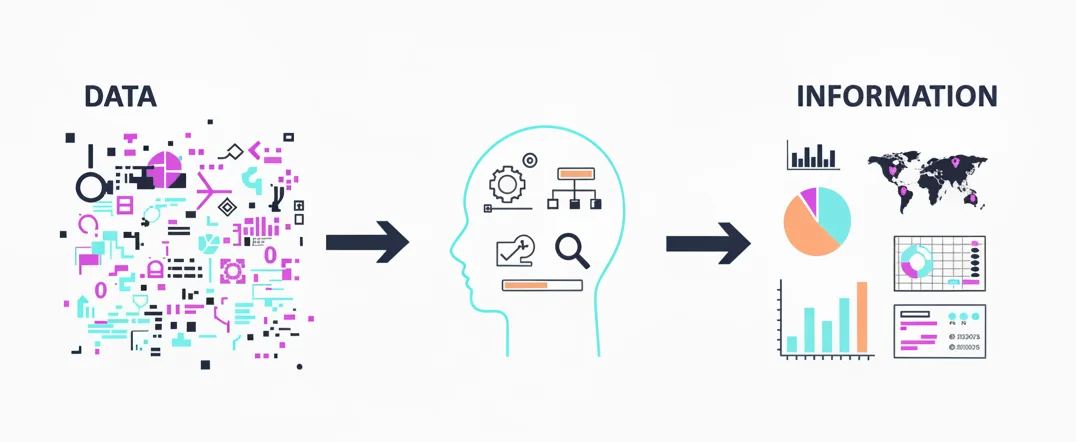
Data is the raw material, while Information is the output product that has been organized, processed, and placed in a specific context.
| Criterion | Data | Information |
|---|---|---|
| Processing Level | Raw, unprocessed. | Processed, organized, with context. |
| Meaning | Discrete, lacks meaning when standing alone. | Meaningful, useful for decision-making. |
| Relationship | Is the input raw material. | Is the output product of the data processing process. |
To illustrate, discrete data fragments like "The number 170" and the word "height" do not offer specific utility when standing alone. However, when processed and organized into Information such as "The average height of male employees is 170cm" it becomes meaningful and useful. It can then be directly used to make personnel decisions or design a workspace.
4. The Role of Data
Data plays a crucial role in all fields, especially in the modern business environment:
- Supports Decision-Making: Analyzed data (turned into information) provides a solid basis for businesses to make smart business decisions, instead of relying on intuition.
- Analysis and Prediction: Historical data helps analyze trends, patterns, and build predictive models for the future (e.g., sales forecasting, market trends).
- Improves Operations: Monitoring operational data helps businesses identify weaknesses, optimize workflows, and enhance performance.